Tuesday, May 28, 2013

Pocket Ironer

From the archives of All things Ironing - Ironing Gadgets.

You are about to go in for that important interview and notice the crease on your sleeve isn’t quite razor sharp. The impressive tie you chose just for this occasion could be just a bit flatter.
 
No problem. Just reach into your pocket and activate your Pocket Ironer. Your personal standby ironer is ready to spring into action to make sure you put your best wrinkle-free foot forward.
 
The Pocket Ironer is compact.
The Pocket Ironer is versatile and easy to use.
Battery powered, the Pocket Ironer can be conveniently charged with a USB cable directly from your computer and comes with a clip attachment to hold the crease for easier ironing. 
 

The Pocket Ironer measures just 100mm x 60mm x 18mm and weighs in at only 60 grams.


The manufacturer claims that anything you wear that folds and can use a little extra ironing can be put right at a moment's notice.


Tuesday, May 7, 2013

17 billion dollars

Opinion
 
Yesterday, I posted my thoughts about the 12 billion dollar hole in the government's budget. This morning, the finance minister Penny Wong announced that the estimated budget shortfall is now going to be 16 to 17 billion.
 
Finance Minister Penny Wong announcing the good news
At this rate, Paul Keating's prediction of a Banana Republic so many years ago seems like paradise.
 
Obviously, not being the first person to ask them selves this question, I followed a few links on the internet to find some graphics to illustrate just what a billion dollars looks like. To illustrate, I found these graphics courtesy of The Society Pages.
 
This is what 1 Million Dollars looks like.


This is what 100 Million Dollars looks like.


This is what 1 Billion Dollars looks like.


and this is what 17 Billion Dollars looks like.


" I think we need a bigger hole..."

Osca

Monday, May 6, 2013

12 billion dollars

Opinion.
 
Recently, our Prime Minister announced a 12 billion dollar shortfall in the government budget and it got me thinking. Just how much is 12 billion dollars exactly?
 
$12,000,000,000.00
 
"It's here somewhere..."
 
It is such a large number, one finds it difficult to wrap one's brain around.
 
Depending on the industry, some people earn less then or close to $20.00 an hour. At 12 billion dollars, such a person could have a job for 480,000 years. That's almost seven thousand lifetimes.
 
Even at $100,000.00 a year, considered to be a good income that most of the population only dream of, one could earn such income for 120,000 years.
 
or
 
a hundred and twenty thousand jobs for a year. Gone !
 
It seems incredible to me that such numbers can be announced by our government so casually, as if everything is just fine. Oh, we made a mistake in our calculations a half a year ago. Oh, it's not really our fault, the dollar is too high. But we want your vote in September. Trust us, we know what we are doing.

Osca.

Monday, April 29, 2013

Armand Gautier (1825-1894)

From the archives of All things Ironing - Ironers in oils.

Amand Gautier (1825-1894), a French painter and lithographer, he began as an apprentice lithographer but displayed such a talent for drawing that in 1845 his parents enrolled him at the Académie in Lille, where he studied under the sculptor Augustin-Phidias Cadet de Beaupré.


Armand Gautier - A woman ironing - etching
from Eaux Fortes Modernes 1864.
Armand Gautier - A woman ironing - oil on canvas
Musee des Beaux-Arts, Caen, France
In 1847–50 he worked in the studio of the Neo-classical painter François Souchon (1787–1857).
 
In 1852 he received a scholarship to study at the Ecole des Beaux-Arts in Paris with Léon Cogniet.

He frequented the Brasserie Andler where he met many of the artists who exhibited at the Salon, particularly the Realists.
 
Gautier himself made his début at the Salon in 1853 with Thursday Promenade. He shared living-quarters with Paul Gachet, a close friend whom he had known from his days in Lille. Gachet, who was a doctor, introduced Gautier to the environment of such hospitals as La Salpêtrière, and this influenced the direction his art was to take.


Armand Gautier - Salpetriere - lithograph 1857
showing personifications of dementia, megalomania, acute mania,
melancholia, idiocy, hallucination, erotomania and paralysis.
in the gardens of the Hospice de la Salpêtrière.
He was authorized to execute a large number of studies of lunatics in the specialized asylum, continuing the tradition begun some 30 years earlier by Gericault with his scientifically realistic series of monomaniacs.
 
Gautier was fascinated by this experience and, as a result, painted his best-known work, the Madwomen of La Salpêtrière (destr. 1870). When the painting was exhibited in 1857 at the Salon in Paris, it was a resounding success, acclaimed not only by Maxime Du Camp but also by Jules-Antoine Castagnary, Théophile Gautier and Charles Baudelaire.

The originality of its conception and the virtuosity of its technique made the painting a significant example of Realism, worthy of being placed in the same category as the works of his master and friend Courbet. Their friendship was such that in 1867 Courbet painted Gautier’s portrait (Lille, Mus. B.-A.).
 
Jean Desire Gustave Courbet (1819–1877) - Gautier Portrait - oil
During this time he actively sought a patron, and eventually found one in Louis-Joachim Gaudibert (1838–70), a wealthy shipowner from Le Havre who had already helped Monet and Eugène Boudin.
Gautier became friends with these artists who were interested in unconventional ways of painting; he was particularly close to Monet, whom he advised early in the latter’s career.
 
He took part in the first Salon des Refusés in 1863, exhibiting The Adulteress (1860; untraced). During this time financial needs prompted him to paint portraits for the Salons, where they were favourably reviewed by critics, who compared him to Carolus-Duran. Along with Courbet, he was a member of the revolutionary movement of the Commune and because of his activities was arrested and sentenced in June 1871.
 
He began exhibiting again at the Salon from 1874, showing portraits, still-lifes and religious scenes, and continued to do so until 1888, but these works did not have the conviction of his earlier ones. In his last years he became a recluse in the village of Ecouen and was eventually put in a retirement home by friends.
 
Research Links 
 
 
All images contained on this website are copyrighted property of their respective owners.
All rights reserved.

Monday, April 8, 2013

Sunbeam Verve 68 Iron Review

From the archives of All things Ironing - an Iron review.

A long time ago, we have made the choice for environment versus productivity when selecting our ironing equipment.  Having used commercial ironing machines for a decade, we decided to switch to much more environmentally friendly domestic irons about twelve years ago.

For one, domestic irons use a miniscule amount of electricity in comparison to the bulky, commercial, almost industrial machines and it is a lot easier and cheaper to replace a small iron in a matter of minutes than to have to be without an iron for up to two weeks sometimes, to have the commercial equipment repaired. Usually at great expense. 

Having tested all the domestic models available at the time, we settled on the Sunbeam range of Irons for quite a few reasons. The top of the range Sunbeam irons offer :
 
  • Excellent 2400 watts initial heat-up, the iron is ready faster.
  • Faster heat recovery during ironing, and therefore better, consistent quality.
  • An excellent, more even spread of steam through the sole plate (172 steam holes) and a powerful shot of steam.
  • Ergonomic design. This is particularly important in the case of using the irons on a semi commercial basis as we do for instance where the ironer is using the iron for 4 hours or more at a time. The weight distribution, rest position, water filling position are all important in reducing repetitive straining from a full time ironer's point of view.
  • Full length button groove seems to have been almost forgotten by other manufacturers, yet is vital in reducing damage to buttons and allowing for a much smoother finish, especially to the important bodice and placket areas of a shirt.
  • Resilium, durable scratch free base plate that truly does glide better than others.
Sunbeam Verve features
sunbeam verve pdf
 
In addition, the Sunbeam irons are closer to Australian made than any other brand and we always prefer to choose and use Australian made products. Although no longer made in Australia, according to the Sunbeam website, the design team and administration is still based in Australia and New Zealand.

During the last 10 years, Sunbeam has upgraded and re-designed their range a number of times and unfortunately, our experience has been that with each new model, the irons last a little less time.

Admittedly, we put the irons through their paces, with each iron ironing between 4 and 7 hours a day and Sunbeam makes a clear distinction in the warranty between domestic use (2 years) and commercial use (3 months). However, where the irons made 10 years ago mostly lasted over a year, the latest models hardly make it through two weeks of ironing on average (20 to 35 hours of ironing) before some component fails.
 
Yes, plainly we are within our rights to claim warranty each time the iron fails within the three month warranty period that applies to commercial use, however, it just seems plain silly to just pass this problem onto the retail supplier that we buy our irons from.
 
As it is usually one or other small component which makes the irons unusable, the next obvious step was to try and have the irons repaired by an authorised ironing equipment repair shop.
 
Unfortunately, this avenue failed also as we were assured by more than one repair specialist that Sunbeam does not provide spare parts and as such the iron can not be repaired and we should claim warranty. Back to square one.
 
Just to clarify, I have no way of confirming whether Sunbeam does or does not supply spare parts.
 
I have personally tried to communicate with Sunbeam about these issues on a number of occasions, considering we currently use 20 or more irons a year and can probably offer excellent feedback, but to no avail. My emails remain unanswered.
 
Continually returning the irons to our supplier (Good Guys) who have never refused a warranty claim, just seems an awkward waste of time and effort on everyone's behalf.
 
By now, you are probably wondering why we don't simply use another brand.
 
Simply, because the Sunbeam Verve iron is still the best on the market (when it works) in my opinion, having recently again gone through the exercise of testing the other available brands.
 
So where to from here?
 
I have decided to see if I can fix the irons my self.
 
The main problems we encounter are :
 
  • Loss of the shot of steam. There have been instances when this feature does not work at all on a brand new, just plugged in iron. Odd, considering it is the most prominent feature highlighted in advertising of the Sunbeam irons. Mostly though, the released steam gets weaker and weaker over a period of hours of ironing and eventually stops all together or just water comes through making it impossible to use the iron to iron.
 
  • The buttons used for the shot of steam and water spray sometimes just pop out. This is either a problem with the design or a poorly made component because the small plastic tab breaks too easily.
 Shot of steam button and clip holding it in place
  • Water fill inlet cover locking tab which is in place to stop water splashing out from the water chamber during ironing eventually snaps off regardless of how careful we are using it. Same reason as above I suspect.
 Water fill inlet cover locking tab
  • The shot of steam or water spray assembly comes apart. I have discovered this on one occasion when the button popped out and the rubber seal was still inside the spray chamber. In fact, it was this discovery that has led me to have the confidence of attempting some minor repairs my self.
 
Water spray button assembly 
 
  • On several occasions, when an iron gets older, water starts to seep from somewhere between the iron water tank assembly and the base plate. This can cause a short circuit and usually blows the fuse on our electrical board.
 
  • Of course, any time water starts to leak out of the iron in any manor, it becomes useless as an ironing tool.  
 
  • Rarely, in fact only once in all the years that we have used Sunbeam irons does it happen that a new iron refuses to heat up once plugged in.
 
  • With a test sample of at least 50 Sunbeam Verve irons, it is seldom for an iron last more than 3 months ( 250 to 400 ironing hours ) in our semi-commercial setting unless helped with some easy repairs.  
To be fair to Sunbeam, I suspect these small, yet vital breakdowns are more to do with the manufacturing process and materials used than the design its self. More a symptom of the consumer desire for cheaper products which has seen most Australian manufacturing outsourced off shore where I guess there are not as many strict quality checks that I would expect if the manufacturing was done locally.
 

Sunbeam Verve 68 Iron Quick Review

Test sample - over 50 Sunbeam Verve 68 Irons. Testing period for each iron - about three months (250 to 400 ironing hours)

Problems encountered                                                    Frequency

New iron not heating up                                                      Only once

Shot of steam stops working                                               Most
(have found a way of repairing)

Shot of steam button breaks off                                           Many

Water fill inlet cover locking tab breaks off                            Most
(able to repair some by using parts from old irons)

Thermostat failing or not working                                         Never

Water leaking from within the assembly                               Rare              


Attempting safe minor repairs
 
I have taken one iron apart to see which old components can be kept from the failed irons and used for repairs.
 
Sunbeam Verve iron disassembled
You can see that I have stopped when I got to the heating element assembly (top left). For one, it appears fused and there might be a good reason. I suspect that asbestos is used quite often to insulate heating elements as I was able to confirm with a quick search of the internet - even in hair dryers.
 
All up, around 100 components. A good reason for Sunbeam not to be supplying every appliance repairer with spare parts.
 
But as I said above, most of the new irons don't make it through three months without a breakdown so I have taken to keeping the dysfunctional irons for spare parts and attempted some repairs my self, extending the useful life of an iron well past the three month period specified in the warranty.
 
The other measure we have taken is to build into the price of our product a lifespan of 3 months per iron along with a guarantee that our irons are kept in peak condition and replaced every three months which avoids other problems such as rust and scale build-up within the iron its self which occur with any iron despite us using only filtered water.
 
To be fair, the cost incurred if an iron does last the three months is around $100.00 per iron which is as little as $0.25 per ironing hour or a couple of cents per item ironed so it is no big deal.
 
Shot of steam stops working
 
There are three reasons for the shot of steam to stop working.
 
A      The button clip holding it in place breaks and the button pops out.
 
 Shot of steam button and clip holding it in place
 
 
Gently ease a spare button into the spray chamber until it clicks into position. making sure the rubber stopper is not dislodged in the process.
 
Do not ad oil based lubricant as it may seep into the steam and leave marks on the ironing. 
 
B      The button becomes difficult to press and only very little steam shot is produced.
 
 
Sometimes, the rubber stopper (3) separates from the button and becomes lodged in the spray chamber. Also, the wire mesh filter (5) could have become clogged with impurities in the water used to fill the water tank.
 
Figure 1
Using a small flat head screwdriver, gently press the holding clip in until the button becomes loose. remove the button. You should see the rubber stopper (3) inside the chamber and a small washer (2).
 
Remove these from the chamber by gently sliding them out with a thin screwdriver. Do not scratch the wall of the chamber. If you decide to turn the iron upside down, ensure there is no water in the water tank.
 
Place the washer (2) into the button (1) so it is flat. Then replace the rubber stopper firmly (make sure the button and the inside button chamber are dry), checking that it is firmly in place. Once the assembly is complete, the spring will hold the rubber stopper in place.
 
(The design could be improved, as there is nothing holding the rubber stopper in place other than a narrowing of the button chamber)
 
If the spring (4), filter (5) and the steel ball (6) have come out in the process, replace the steel ball first (the steam chamber has a small indentation at the bottom that it fits into). Clean the filter if necessary and place it flat into the steam chamber. Insert the spring (4). You may want to stretch the spring a little to create more resistance and pressure on the rubber stopper to hold it in place.
 
Follow the instructions (A) in replacing the button.
 
C     If the above methods do not resolve the problem, chances are the fault lies in the iron assembly its self or an electronic component. You'll need to get a new iron.
 
.    .    .
 
Water fill inlet cover locking tab breaks off   
 
 
If you have a spare door, it is quite easy to replace.
 
1     Remove the steam buttons as above (Figure 1).
 
2     Remove the two screws using a small phillips screwdriver.
 
 
3     Remove the cover.
 
 
4     At this point you can easily remove the fill inlet cover and replace it.
 
 
5     Re-assemble the iron and happy ironing.
 
 
(Sunbeam has been approached to offer comment 7 days prior to the publishing of this article but has not responded to my invitation at this time.)


Thursday, March 14, 2013

Mary Shelley - American folk artist

From the archives of All things Ironing - An iron in pine and acrylics.

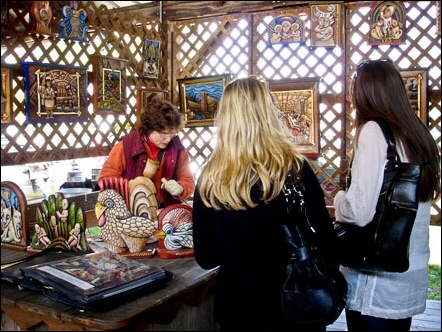
Mary's art works are entirely carved in white pine, painted with acrylics and each piece is unique and original.

Mary says about her self on her web page that she is untaught and untrained as a visual artist, but has learned a number of useful skills by building her own house and during her work in the trades as a sign painter and carpenter.

 
Mary Shelley -  A carving of a lady ironing from 2003

Mary's artwork has been described as primitive, traditional, untrained, Americana, whimsical, naive, eccentric, outsider, visionary or carved craft.

In Mary's words, she is best known for carved folk art paintings of waitresses, diners, animals, cows, farms, sailboats, central New York regional themes, and special order commissions.
 

Mary Michael Shelley - An American folk artist

Like so many artists that are unstoppably driven to express them selves, Mary uses art to explore and make sense of life events, dreams and emotions, sometimes calling her artwork a "picture diary" or "picture story".
 
According to Mary's website, since 1974 Mary has completed approximately 1500 carved and painted wood pictures. For fourteen of those years supplementing her art income by working as a sign painter and carpenter.
 
Since 1990 Mary has worked as a psychotherapist, and thus, in her words, "You might notice a focus in my work on people - their faces, suffering, hopes, endurance and beauty."


You can find Mary carving every summer Saturday at the Ithaca Farmers' Market.


Monday, March 4, 2013

Smile

From the archives of the Osca delivery run.

The pick up and delivery run isn't always about trying to stay calm while negotiating Melbourne's traffic. Ocassionally, something just jumps out and puts a smile on one's face and it is worth taking a picture to share with you.


"A smile is happiness you will find right under your nose"

Meanwhile, the debate continues about the future of printed newspapers and the reasons for declining readership. A sign next to a pile of neatly arranged newspapers on a nature strip perhaps offers a clue.

Thursday, February 7, 2013

Johnny Depp Ironing

From the archives of All things Ironing - Johnny Depp Ironing.

In the movie Benny & Joon, Sam (Johnny Depp) and Juniper "Joon" (Mary Stuart Masterson), find each other and fall in love.

Filmed in 1993, this romantic comedy is perhaps best known for Depp's humorous physical comedy routines based on silent film comics Buster Keaton and Charlie Chaplin.

Johnny Depp on set of Benny & Joon
Johnny Depp, clad in a ric-rac-trimmed apron, is an appealing figure as he cooks a stack of grilled cheese sandwiches using an iron.

Scene from Benny & Joon
 
But would this technique actually work ?
 
This Web site illustrates one couple's adventures in making grilled cheese sandwiches with an iron "the Benny and Joon way." They discovered that the film may have taken some liberties in cooking accuracy, perhaps for the sake of comedy.
 
One caution though. Whilst it may be fun to iron your toast in the morning, consider using a protective layer of foil or waxed paper, lest you want burnt-cheese flavoured shirts to wear to the office.
 
research links
 

Monopoly Iron gone for ever

From the archives of All things Ironing - History in the making.

Today we farewell one of the iconic Monopoly pieces, the iron.


Iron out, Cat in
In a marketing coup, Monopoly has had the internet world abuzz for weeks while anyone with access and the desire has had their say in determining which of the iconic pieces is to be replaced.

People from 185 countries (Monopoly is being sold in 111), have taken part.
 

Considered options for a new Monopoly token
 
The choice was clear. A toy robot, a guitar, a helicopter a diamond ring and a cat, all vying for the opportunity to pass 'Go'  for the first time.

"While we're a bit sad to see the iron go, the cat token is a fantastic choice by the fans and we have no doubt it will become just as iconic as the original tokens," said Eric Nyman, from game maker Hasbro.

The cat, which has no name, received 31% of votes for new tokens.

"We know that cat lovers around the world will be happy to welcome the new cat token into the Monopoly game."

So what of the history of the Monopoly tokens.


Here's the official line straight from Hasbro, current copyright holder for Monopoly:


Hasbro Toys Australia
With the tokens serving as such an important part of the game experience, it's hard to imagine the game without them. However, the first game produced in 1935 did not include tokens. Charles Darrow, who originally brought the game to Parker Brothers, recommended that players use household items like buttons and pennies to move around the board.

Parker Brothers decided to include mover-tokens in the game. The edition produced from 1935-36 included four small wax wood pieces, or pawns. In 1937 Parker Brothers, determined to preserve the game''s tradition, decided to produce die-cast metal tokens that were reminiscent of objects found in households across America. This decision marked the introduction of the flatiron, purse, lantern, car, thimble, shoe, top hat, and the rocking horse. The top hat was modeled after the chapeau of the game's Chairman of the Board, Mr. Monopoly, and the car, his 1930s roadster.

Two additional tokens, the battleship and the cannon, were also added in 1937. They were used at the time, in another Parker Brothers game called Conflict, which made it easy to add this pair to the Monopoly game. These 10 tokens--flatiron, purse, lantern, car, thimble, shoe, top hat, rocking horse, battleship and cannon--were used until 1942.

With World War II came a metal shortage in the United States. As a result, during the years 1943-47, Monopoly games contained tokens made out of wood. Shortly after the end of World War II the metal tokens were brought back to the game.

The early 1950s brought the addition of three new tokens and the departure of three original tokens. The lantern, purse and rocking horse were replaced by the dog (Mr. Monopoly's dog, Scotty), the wheelbarrow and the horse and rider. These three MONOPOLY game tokens still exist in the classic edition.

From February 5, 2013, the iron will no longer be included among the playing pieces.
So the tokens were not designed to signify anything by the game's designer who wanted people to use tokens from around the house. Many people carry out this tradition, either by using coins for missing tokens or borrowing tokens from other games.
 
research links

abc article
hasbrotoys
straightdope


Wednesday, February 6, 2013

Henry Robert Morland (1716-1797)

From the archives of All things Ironing - Irons in oils.


Many sources say he was the son of a painter George Henry Moreland, but in fact his parents were Thomas and Elizabeth Morland.
 
Henry Robert was born on 6.10.1716 and baptised on 20.11.1716 in Westminster.

He is next mentioned in documents when he was apprenticed to the minor portrait painter and Kneller copyist Isaac Whood of Bloomsbury on 21.9.1732 for 7 years at 40 pounds per annum.
 
Das Waschermadel
Laundry Maid Ironing 1765
Woman Ironing 1782
Laundry Maid Ironing 1785
By 1753 he was established as a painter in oil and crayons of portraits and genre pictures, as well as being "a maker of most excellent crayons, which went by his name. He was also a dealer, restorer and forger. Despite notable success, he was declared bankrupt in 1762 (London Gazette, 23.1.1762).
 
The connoisseur 1840
He appeared in directories as a portrait painter from 1763 and continued to exhibit pastels at the Society of Artists (1760-1783) and the Royal Academy (1771-1781), including portraits and genre pictures of domestic servants.

Research links

Its About Time
Colonial Quills
A polarbears tale
Aprosagok Csetreszek Regisegek
World Visit Guide
Pastelists (PDF)

Wednesday, January 30, 2013

Ironing a million items. How would you feel

From the Archives of all things Ironing - Ironing in the News

This is a story about Val Robson, who has ironed over a million items of clothing in 30 years of service as it appeared on the Belfast Telegraph website on the 22nd of January 2013,


Laundry manager Val Robson


A laundry manager who has ironed more than a million items of clothing in her 30 years' service said she only meant to cover a fortnight's maternity leave.

Val Robson, 56, puts on 30 washes and irons more than 180 items a day at Middleton Hall Retirement Village in Middleton St George, near Darlington.

Despite ironing more than 1.1 million items in her time at work, the grandmother still finds motivation on a Friday evening to press her own clothes, as long as she has a glass of red wine and a Westlife CD on.

She said: "I came for a fortnight to cover someone on maternity leave and I've been here ever since.

"I get a lot of job satisfaction from coming in on a morning and seeing rows of empty baskets, and then seeing them all full of fresh, clean clothes when I've finished. I never stop.

"It's go, go, go all the time - but it keeps me fit. A million pieces seems like a huge amount of ironing but I don't really think about it, I just crack on. It sounds silly to most people but I love my job.

"I think most people wouldn't want to see the ironing board again if they did it for a living, but I don't mind at all.

"It's my Friday evening sorted - a pile of ironing, a glass of wine and Westlife."


Jeremy Walford, the Village's managing director, who awarded her a bouquet of flowers and a meal for two, said: "Val is one of our longest-serving employees and her work ethos and dedication to our residents is fantastic.

"She has so much energy and a pride for what she does. No one can get through the laundry as fast as Val and she always ensures the quality is there too."

Link to this story at Belfast Telegraph