Monday, April 8, 2013

Sunbeam Verve 68 Iron Review

From the archives of All things Ironing - an Iron review.

A long time ago, we have made the choice for environment versus productivity when selecting our ironing equipment.  Having used commercial ironing machines for a decade, we decided to switch to much more environmentally friendly domestic irons about twelve years ago.

For one, domestic irons use a miniscule amount of electricity in comparison to the bulky, commercial, almost industrial machines and it is a lot easier and cheaper to replace a small iron in a matter of minutes than to have to be without an iron for up to two weeks sometimes, to have the commercial equipment repaired. Usually at great expense. 

Having tested all the domestic models available at the time, we settled on the Sunbeam range of Irons for quite a few reasons. The top of the range Sunbeam irons offer :
 
  • Excellent 2400 watts initial heat-up, the iron is ready faster.
  • Faster heat recovery during ironing, and therefore better, consistent quality.
  • An excellent, more even spread of steam through the sole plate (172 steam holes) and a powerful shot of steam.
  • Ergonomic design. This is particularly important in the case of using the irons on a semi commercial basis as we do for instance where the ironer is using the iron for 4 hours or more at a time. The weight distribution, rest position, water filling position are all important in reducing repetitive straining from a full time ironer's point of view.
  • Full length button groove seems to have been almost forgotten by other manufacturers, yet is vital in reducing damage to buttons and allowing for a much smoother finish, especially to the important bodice and placket areas of a shirt.
  • Resilium, durable scratch free base plate that truly does glide better than others.
Sunbeam Verve features
sunbeam verve pdf
 
In addition, the Sunbeam irons are closer to Australian made than any other brand and we always prefer to choose and use Australian made products. Although no longer made in Australia, according to the Sunbeam website, the design team and administration is still based in Australia and New Zealand.

During the last 10 years, Sunbeam has upgraded and re-designed their range a number of times and unfortunately, our experience has been that with each new model, the irons last a little less time.

Admittedly, we put the irons through their paces, with each iron ironing between 4 and 7 hours a day and Sunbeam makes a clear distinction in the warranty between domestic use (2 years) and commercial use (3 months). However, where the irons made 10 years ago mostly lasted over a year, the latest models hardly make it through two weeks of ironing on average (20 to 35 hours of ironing) before some component fails.
 
Yes, plainly we are within our rights to claim warranty each time the iron fails within the three month warranty period that applies to commercial use, however, it just seems plain silly to just pass this problem onto the retail supplier that we buy our irons from.
 
As it is usually one or other small component which makes the irons unusable, the next obvious step was to try and have the irons repaired by an authorised ironing equipment repair shop.
 
Unfortunately, this avenue failed also as we were assured by more than one repair specialist that Sunbeam does not provide spare parts and as such the iron can not be repaired and we should claim warranty. Back to square one.
 
Just to clarify, I have no way of confirming whether Sunbeam does or does not supply spare parts.
 
I have personally tried to communicate with Sunbeam about these issues on a number of occasions, considering we currently use 20 or more irons a year and can probably offer excellent feedback, but to no avail. My emails remain unanswered.
 
Continually returning the irons to our supplier (Good Guys) who have never refused a warranty claim, just seems an awkward waste of time and effort on everyone's behalf.
 
By now, you are probably wondering why we don't simply use another brand.
 
Simply, because the Sunbeam Verve iron is still the best on the market (when it works) in my opinion, having recently again gone through the exercise of testing the other available brands.
 
So where to from here?
 
I have decided to see if I can fix the irons my self.
 
The main problems we encounter are :
 
  • Loss of the shot of steam. There have been instances when this feature does not work at all on a brand new, just plugged in iron. Odd, considering it is the most prominent feature highlighted in advertising of the Sunbeam irons. Mostly though, the released steam gets weaker and weaker over a period of hours of ironing and eventually stops all together or just water comes through making it impossible to use the iron to iron.
 
  • The buttons used for the shot of steam and water spray sometimes just pop out. This is either a problem with the design or a poorly made component because the small plastic tab breaks too easily.
 Shot of steam button and clip holding it in place
  • Water fill inlet cover locking tab which is in place to stop water splashing out from the water chamber during ironing eventually snaps off regardless of how careful we are using it. Same reason as above I suspect.
 Water fill inlet cover locking tab
  • The shot of steam or water spray assembly comes apart. I have discovered this on one occasion when the button popped out and the rubber seal was still inside the spray chamber. In fact, it was this discovery that has led me to have the confidence of attempting some minor repairs my self.
 
Water spray button assembly 
 
  • On several occasions, when an iron gets older, water starts to seep from somewhere between the iron water tank assembly and the base plate. This can cause a short circuit and usually blows the fuse on our electrical board.
 
  • Of course, any time water starts to leak out of the iron in any manor, it becomes useless as an ironing tool.  
 
  • Rarely, in fact only once in all the years that we have used Sunbeam irons does it happen that a new iron refuses to heat up once plugged in.
 
  • With a test sample of at least 50 Sunbeam Verve irons, it is seldom for an iron last more than 3 months ( 250 to 400 ironing hours ) in our semi-commercial setting unless helped with some easy repairs.  
To be fair to Sunbeam, I suspect these small, yet vital breakdowns are more to do with the manufacturing process and materials used than the design its self. More a symptom of the consumer desire for cheaper products which has seen most Australian manufacturing outsourced off shore where I guess there are not as many strict quality checks that I would expect if the manufacturing was done locally.
 

Sunbeam Verve 68 Iron Quick Review

Test sample - over 50 Sunbeam Verve 68 Irons. Testing period for each iron - about three months (250 to 400 ironing hours)

Problems encountered                                                    Frequency

New iron not heating up                                                      Only once

Shot of steam stops working                                               Most
(have found a way of repairing)

Shot of steam button breaks off                                           Many

Water fill inlet cover locking tab breaks off                            Most
(able to repair some by using parts from old irons)

Thermostat failing or not working                                         Never

Water leaking from within the assembly                               Rare              


Attempting safe minor repairs
 
I have taken one iron apart to see which old components can be kept from the failed irons and used for repairs.
 
Sunbeam Verve iron disassembled
You can see that I have stopped when I got to the heating element assembly (top left). For one, it appears fused and there might be a good reason. I suspect that asbestos is used quite often to insulate heating elements as I was able to confirm with a quick search of the internet - even in hair dryers.
 
All up, around 100 components. A good reason for Sunbeam not to be supplying every appliance repairer with spare parts.
 
But as I said above, most of the new irons don't make it through three months without a breakdown so I have taken to keeping the dysfunctional irons for spare parts and attempted some repairs my self, extending the useful life of an iron well past the three month period specified in the warranty.
 
The other measure we have taken is to build into the price of our product a lifespan of 3 months per iron along with a guarantee that our irons are kept in peak condition and replaced every three months which avoids other problems such as rust and scale build-up within the iron its self which occur with any iron despite us using only filtered water.
 
To be fair, the cost incurred if an iron does last the three months is around $100.00 per iron which is as little as $0.25 per ironing hour or a couple of cents per item ironed so it is no big deal.
 
Shot of steam stops working
 
There are three reasons for the shot of steam to stop working.
 
A      The button clip holding it in place breaks and the button pops out.
 
 Shot of steam button and clip holding it in place
 
 
Gently ease a spare button into the spray chamber until it clicks into position. making sure the rubber stopper is not dislodged in the process.
 
Do not ad oil based lubricant as it may seep into the steam and leave marks on the ironing. 
 
B      The button becomes difficult to press and only very little steam shot is produced.
 
 
Sometimes, the rubber stopper (3) separates from the button and becomes lodged in the spray chamber. Also, the wire mesh filter (5) could have become clogged with impurities in the water used to fill the water tank.
 
Figure 1
Using a small flat head screwdriver, gently press the holding clip in until the button becomes loose. remove the button. You should see the rubber stopper (3) inside the chamber and a small washer (2).
 
Remove these from the chamber by gently sliding them out with a thin screwdriver. Do not scratch the wall of the chamber. If you decide to turn the iron upside down, ensure there is no water in the water tank.
 
Place the washer (2) into the button (1) so it is flat. Then replace the rubber stopper firmly (make sure the button and the inside button chamber are dry), checking that it is firmly in place. Once the assembly is complete, the spring will hold the rubber stopper in place.
 
(The design could be improved, as there is nothing holding the rubber stopper in place other than a narrowing of the button chamber)
 
If the spring (4), filter (5) and the steel ball (6) have come out in the process, replace the steel ball first (the steam chamber has a small indentation at the bottom that it fits into). Clean the filter if necessary and place it flat into the steam chamber. Insert the spring (4). You may want to stretch the spring a little to create more resistance and pressure on the rubber stopper to hold it in place.
 
Follow the instructions (A) in replacing the button.
 
C     If the above methods do not resolve the problem, chances are the fault lies in the iron assembly its self or an electronic component. You'll need to get a new iron.
 
.    .    .
 
Water fill inlet cover locking tab breaks off   
 
 
If you have a spare door, it is quite easy to replace.
 
1     Remove the steam buttons as above (Figure 1).
 
2     Remove the two screws using a small phillips screwdriver.
 
 
3     Remove the cover.
 
 
4     At this point you can easily remove the fill inlet cover and replace it.
 
 
5     Re-assemble the iron and happy ironing.
 
 
(Sunbeam has been approached to offer comment 7 days prior to the publishing of this article but has not responded to my invitation at this time.)


Thursday, March 14, 2013

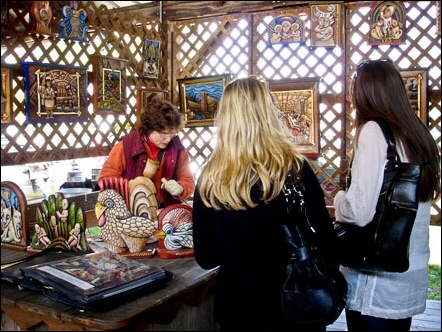
Mary Shelley - American folk artist

From the archives of All things Ironing - An iron in pine and acrylics.

Mary's art works are entirely carved in white pine, painted with acrylics and each piece is unique and original.

Mary says about her self on her web page that she is untaught and untrained as a visual artist, but has learned a number of useful skills by building her own house and during her work in the trades as a sign painter and carpenter.

 
Mary Shelley -  A carving of a lady ironing from 2003

Mary's artwork has been described as primitive, traditional, untrained, Americana, whimsical, naive, eccentric, outsider, visionary or carved craft.

In Mary's words, she is best known for carved folk art paintings of waitresses, diners, animals, cows, farms, sailboats, central New York regional themes, and special order commissions.
 

Mary Michael Shelley - An American folk artist

Like so many artists that are unstoppably driven to express them selves, Mary uses art to explore and make sense of life events, dreams and emotions, sometimes calling her artwork a "picture diary" or "picture story".
 
According to Mary's website, since 1974 Mary has completed approximately 1500 carved and painted wood pictures. For fourteen of those years supplementing her art income by working as a sign painter and carpenter.
 
Since 1990 Mary has worked as a psychotherapist, and thus, in her words, "You might notice a focus in my work on people - their faces, suffering, hopes, endurance and beauty."


You can find Mary carving every summer Saturday at the Ithaca Farmers' Market.


Monday, March 4, 2013

Smile

From the archives of the Osca delivery run.

The pick up and delivery run isn't always about trying to stay calm while negotiating Melbourne's traffic. Ocassionally, something just jumps out and puts a smile on one's face and it is worth taking a picture to share with you.


"A smile is happiness you will find right under your nose"

Meanwhile, the debate continues about the future of printed newspapers and the reasons for declining readership. A sign next to a pile of neatly arranged newspapers on a nature strip perhaps offers a clue.

Thursday, February 7, 2013

Johnny Depp Ironing

From the archives of All things Ironing - Johnny Depp Ironing.

In the movie Benny & Joon, Sam (Johnny Depp) and Juniper "Joon" (Mary Stuart Masterson), find each other and fall in love.

Filmed in 1993, this romantic comedy is perhaps best known for Depp's humorous physical comedy routines based on silent film comics Buster Keaton and Charlie Chaplin.

Johnny Depp on set of Benny & Joon
Johnny Depp, clad in a ric-rac-trimmed apron, is an appealing figure as he cooks a stack of grilled cheese sandwiches using an iron.

Scene from Benny & Joon
 
But would this technique actually work ?
 
This Web site illustrates one couple's adventures in making grilled cheese sandwiches with an iron "the Benny and Joon way." They discovered that the film may have taken some liberties in cooking accuracy, perhaps for the sake of comedy.
 
One caution though. Whilst it may be fun to iron your toast in the morning, consider using a protective layer of foil or waxed paper, lest you want burnt-cheese flavoured shirts to wear to the office.
 
research links
 

Monopoly Iron gone for ever

From the archives of All things Ironing - History in the making.

Today we farewell one of the iconic Monopoly pieces, the iron.


Iron out, Cat in
In a marketing coup, Monopoly has had the internet world abuzz for weeks while anyone with access and the desire has had their say in determining which of the iconic pieces is to be replaced.

People from 185 countries (Monopoly is being sold in 111), have taken part.
 

Considered options for a new Monopoly token
 
The choice was clear. A toy robot, a guitar, a helicopter a diamond ring and a cat, all vying for the opportunity to pass 'Go'  for the first time.

"While we're a bit sad to see the iron go, the cat token is a fantastic choice by the fans and we have no doubt it will become just as iconic as the original tokens," said Eric Nyman, from game maker Hasbro.

The cat, which has no name, received 31% of votes for new tokens.

"We know that cat lovers around the world will be happy to welcome the new cat token into the Monopoly game."

So what of the history of the Monopoly tokens.


Here's the official line straight from Hasbro, current copyright holder for Monopoly:


Hasbro Toys Australia
With the tokens serving as such an important part of the game experience, it's hard to imagine the game without them. However, the first game produced in 1935 did not include tokens. Charles Darrow, who originally brought the game to Parker Brothers, recommended that players use household items like buttons and pennies to move around the board.

Parker Brothers decided to include mover-tokens in the game. The edition produced from 1935-36 included four small wax wood pieces, or pawns. In 1937 Parker Brothers, determined to preserve the game''s tradition, decided to produce die-cast metal tokens that were reminiscent of objects found in households across America. This decision marked the introduction of the flatiron, purse, lantern, car, thimble, shoe, top hat, and the rocking horse. The top hat was modeled after the chapeau of the game's Chairman of the Board, Mr. Monopoly, and the car, his 1930s roadster.

Two additional tokens, the battleship and the cannon, were also added in 1937. They were used at the time, in another Parker Brothers game called Conflict, which made it easy to add this pair to the Monopoly game. These 10 tokens--flatiron, purse, lantern, car, thimble, shoe, top hat, rocking horse, battleship and cannon--were used until 1942.

With World War II came a metal shortage in the United States. As a result, during the years 1943-47, Monopoly games contained tokens made out of wood. Shortly after the end of World War II the metal tokens were brought back to the game.

The early 1950s brought the addition of three new tokens and the departure of three original tokens. The lantern, purse and rocking horse were replaced by the dog (Mr. Monopoly's dog, Scotty), the wheelbarrow and the horse and rider. These three MONOPOLY game tokens still exist in the classic edition.

From February 5, 2013, the iron will no longer be included among the playing pieces.
So the tokens were not designed to signify anything by the game's designer who wanted people to use tokens from around the house. Many people carry out this tradition, either by using coins for missing tokens or borrowing tokens from other games.
 
research links

abc article
hasbrotoys
straightdope


Wednesday, February 6, 2013

Henry Robert Morland (1716-1797)

From the archives of All things Ironing - Irons in oils.


Many sources say he was the son of a painter George Henry Moreland, but in fact his parents were Thomas and Elizabeth Morland.
 
Henry Robert was born on 6.10.1716 and baptised on 20.11.1716 in Westminster.

He is next mentioned in documents when he was apprenticed to the minor portrait painter and Kneller copyist Isaac Whood of Bloomsbury on 21.9.1732 for 7 years at 40 pounds per annum.
 
Das Waschermadel
Laundry Maid Ironing 1765
Woman Ironing 1782
Laundry Maid Ironing 1785
By 1753 he was established as a painter in oil and crayons of portraits and genre pictures, as well as being "a maker of most excellent crayons, which went by his name. He was also a dealer, restorer and forger. Despite notable success, he was declared bankrupt in 1762 (London Gazette, 23.1.1762).
 
The connoisseur 1840
He appeared in directories as a portrait painter from 1763 and continued to exhibit pastels at the Society of Artists (1760-1783) and the Royal Academy (1771-1781), including portraits and genre pictures of domestic servants.

Research links

Its About Time
Colonial Quills
A polarbears tale
Aprosagok Csetreszek Regisegek
World Visit Guide
Pastelists (PDF)

Wednesday, January 30, 2013

Ironing a million items. How would you feel

From the Archives of all things Ironing - Ironing in the News

This is a story about Val Robson, who has ironed over a million items of clothing in 30 years of service as it appeared on the Belfast Telegraph website on the 22nd of January 2013,


Laundry manager Val Robson


A laundry manager who has ironed more than a million items of clothing in her 30 years' service said she only meant to cover a fortnight's maternity leave.

Val Robson, 56, puts on 30 washes and irons more than 180 items a day at Middleton Hall Retirement Village in Middleton St George, near Darlington.

Despite ironing more than 1.1 million items in her time at work, the grandmother still finds motivation on a Friday evening to press her own clothes, as long as she has a glass of red wine and a Westlife CD on.

She said: "I came for a fortnight to cover someone on maternity leave and I've been here ever since.

"I get a lot of job satisfaction from coming in on a morning and seeing rows of empty baskets, and then seeing them all full of fresh, clean clothes when I've finished. I never stop.

"It's go, go, go all the time - but it keeps me fit. A million pieces seems like a huge amount of ironing but I don't really think about it, I just crack on. It sounds silly to most people but I love my job.

"I think most people wouldn't want to see the ironing board again if they did it for a living, but I don't mind at all.

"It's my Friday evening sorted - a pile of ironing, a glass of wine and Westlife."


Jeremy Walford, the Village's managing director, who awarded her a bouquet of flowers and a meal for two, said: "Val is one of our longest-serving employees and her work ethos and dedication to our residents is fantastic.

"She has so much energy and a pride for what she does. No one can get through the laundry as fast as Val and she always ensures the quality is there too."

Link to this story at Belfast Telegraph

Thursday, December 13, 2012

Man irons his face

From the Archives of all things Ironing - Ironing in the News

We've heard of Life imitating Art, Well, here is a story where Life imitates a Joke so much so it is hard to believe.

The joke goes something like this -

A man arrives at the emergency presenting with ear burns. The doctor says "How did you burn that ear ?" The man answers that the phone rang and he put the iron to his ear to answer it. "So how did you burn the other ear ?" says the doctor. "Calling for an ambulance" answered the man.

Published by Mail Online UK,  Metro UK and news.com.au, the story is about Tomas Paczkowski who was determined to show his other half he was able to juggle several jobs at once when he accidentally ironed his face after mistaking it for the telephone.

Thomas irons his face and then gets a black eye from running into a door.
Mr Paczkowski from Elbag, Poland - wanted to show his wife Lila that he was a dab hand at chores around the home.

He said: 'I decided to do the ironing while she was out at work, just to prove a point.

'She always complained at me for not doing the housework so I thought I would do the ironing to save her a job and prove to her that I'm not as useless around the house as she thinks.

'Women are always going on about multi-tasking, so I set up the iron, opened a beer and put the boxing on the telly,'
he added.

'It all started out well and I was beginning to think it wasn't that difficult at all. I put up the ironing board in front of the television and started ironing my shirts. The first few went ok.

But Tomasz, 32, added: 'Trouble was, I then got so involved in the boxing that I wasn't really thinking about what I was doing. 

'So when the phone rang I picked up the iron by mistake
and pressed it to my ear.
'I really don't know how I could make such a silly mistake. But I guess it proves men are not able to multitask as well as many women can.

'My wife always watches the soaps when she does the ironing and never has any problems.'

But Tomas added insult to injury when he sprinted to put cold water on the burn - and ran straight into the bathroom door.
'That gave me a black eye so now I look more like I've been in a boxing match instead of just watching one,' he added.

'The pain was incredible. It has also been quite embarrassing to tell everyone how the accident happened, but most people have been very understanding but many of my friends find the whole thing very funny.

'I really don't know how it happened. I was just so engrossed in the television.'

Doctors say he will make a full recovery from the burns - but Tomasz says he's off housework for ever.

'It's harder than it looks. I really respect what my wife does now.'

Wednesday, December 12, 2012

12 12 12

12th of the 12th of the 12th. To many, today is a significant date. The beginning of the end, a time for renewal, of spiritual awakening. To some, just another date.


At Osca, this day marks a very exciting moment, for we have received the first delivery of an Ironing table ordered directly from the manufacturer in England. No longer dependent on the available choice and stock in Melbourne, finding the right table for our future Franchisees and confirming supply is a significant step as another component of the Osca Ironing Franchise Development is put in place.

To celebrate the day, 12 inspirational quotes from 12 inspirational people.

Steve Jobs
an American entrepreneur, founder of Apple
 
"We don't get a chance to do that many things, and every one should be really excellent.
Because this is Our Life.
 
Life is brief and then you die you know?
 
And we've all chosen to do this with our lives. So it better be damned good. It better be worth it." 
 
 
Spryte Loriano
the founder of the Manifest Foundation
 
“Every great story on the planet happened when someone decided not to give up,
but kept going no matter what.”
 
 
Ralph Waldo Emerson
an American essayist, lecturer, and poet
 
"The creation of a thousand forests is in one acorn."
 

Barak Obama
president of the United States of America
 
“Change will not come if we wait for some other person or some other time.
We are the ones we’ve been waiting for.
We are the change that we seek.”
 
 
Oscar Wilde
an Irish writer and poet
“Be yourself; everyone else is already taken.”
 
 
Christopher Columbus
an explorer and navigator
 
“You can never cross the ocean unless you have the courage to lose sight of the shore.“
 
 
Jonathan Swift
an Anglo-Irish satirist, essayist
“May you live all the days of your life.”
 
 
Pandit Jawaharlal Nehru
an Indian politician and statesman

“We live in a wonderful world that is full of beauty, charm and adventure.
There is no end to the adventures we can have if only we seek them with our eyes open.”
 
 
Nicholas Sparks
an American writer and novelist - Author of The Notebook

“We sit silently and watch the world around us. This has taken a lifetime to learn.
It seems only the old are able to sit next to one another and not say anything and still feel content. The young, brash and impatient, must always break the silence.
It is a waste, for silence is pure. Silence is holy.
It draws people together because only those who are comfortable with each other
can sit without speaking.
This is the great paradox.”
 
 
Rick Riordan
an American author best known for writing the Percy Jackson & the Olympians series
 
“Humans see what they want to see.”
 
 
Wayne W. Dwyer
an American self-help author and motivational speaker.

“Change the way you look at things and the things you look at change.”
 
 
Eckhart Tolle
german born, canadian author of The Power of Now
“You are here to enable the divine purpose of the universe to unfold.
That is how important you are!”

Wednesday, December 5, 2012

History of ironing boards

From the Archives of All things Ironing - History of the Ironing board.

The earliest known ironing boards were used by the Vikings in the 9th century.
 
Glass Smoother and Whalebone Ironing Board
Whale meat, blubber, and bones were rare and valuable North Atlantic resources. The refined lady of the house who owned this item would have used it, along with the weight made of imported glass, to smooth her linen.

Far from being the unkempt barbarians of popular imagination, Vikings were extremely fastidious for their time.
Later, in Europe, it became common for people to iron their clothes on the kitchen table, or on a flat piece of board resting between two chairs.  This practice spread to North America and by the early 19th century there was plenty of advice in housekeeping books about what size an ironing table should be, what it should be made of, and what sort of blanket or cloth it should be covered with.

About the same time, several ironing boards started appearing on the market but there is some controversy over who actually invented the ironing board.
 
Vandenburg & Harvey Patent
 
 
On the 16th of February 1858, W.Vandenburg and J.Harvey patented an ironing table that facilitated pressing sleeves and pant legs.

About three years later Isaac Ronnie Bord of Georgetown, Delaware, took out a patent for an adjustable flat horizontal surface for the pressing of undergarments, garments and bed linen.
 
S A Mort Patent
Miss S A Mort obtained a patent for the first truly folding ironing board in 1866.The invention also included a removable press board used for sleeves.
 
Sarah Boone Ironing board
In 1892 Sarah Boone obtained a patent in the United States for improvements to the ironing board, the forerunner of the modern folding ironing board with a narrow, curved shape, designed to make it easy to iron shirts.

 
Manufacturers quickly caught on to the notion of offering ironing boards ready-made by the late nineteenth century. By about 1898, the ironing board came equipped with legs that could be taken down and enabled the board to be set up anywhere. These early manufactured ironing boards were of wood that was supposed to resist warping although they still warped.
 
Wooden Ironing board
This wooden ironing board was made by S. J. Bailey, Inc. in Peru, Indiana, for Sears Roebuck & Co. 
 
New improvements arrived with the use of iron and soon ironing boards had metal-top boards. However, despite painting, the tables still buckled under the heat of the iron. The J. R. Clark Company of Minneapolis began using mesh which permitted steam to escape and prevent buckling and rusting.
Ironing board diagram.
By 1940, all-metal collapsible ironing boards with tubular legs became common. The basic design of the home ironing board has changed little since then.
 
While researching this article, I learned that there is a new ironing board that has won the 2012 Australian International Design Awards. The Hills Orbit ironing board. According to the Hills website,  the new ironing board is full of world first innovations, the Orbit takes the hassle out of housework. 
Hills Orbit
Remarkably similar in construction to the 1940 (72 year old) model wouldn't you say? Although to be fair, there are some nifty ideas and obviously the designers have gone to great length to incorporate many innovative features not found on the average domestic ironing table.

Hills Orbit
As hand ironing moves from the domestic to the commercial environment, the evolution continues.

Magpie ironing table
This ironing table has a temperature regulated heating element incorporated into the table top and a foot operated fan assisted vacuum to draw the steam away from an ironed garment.

Veit Varioline
Weighing in at over 130 kg, the Veit Varioline boasts a suction and blowing table, an iron rest, swivelarm with a sleever and even its own lighting system.

Sources

Thursday, November 22, 2012

Steve Martin Ironing

From the archives of All things Ironing - Humour - Steve Martin ironing

Here is another quirky, ironing related picture from our archive of pictures of famous people ironing.

Steve Martin Ironing
For someone who irons for a living and loves cats, this is a pretty funny image. I wonder how Steve Martin managed to keep a straight face while ironing his hand.

"Extra starch on the collar please." 


Osca Ironing - Stain procedures

About Osca Ironing - Osca Stain Procedures

A page from the Osca Ironers Handbook -

Osca Stain Procedures.

A When you notice an article in a customer's basket that has a stain on it.
1 Stop Ironing.
2 Check Customer Card for any customer 'Stain Instructions' .
· Follow customer instructions.
if there are no customer instructions :
· Seek advice from the Osca Office.
· Follow advice given and proceed as instructed.
3 Write a 'Stain Advice Note' to the customer. Bag or fold garment separately and attach note.
4 Continue Ironing.


B When a stain is caused while ironing.
1 Stop Ironing.
· Determine the origin of the stain.
2a If the stain can be easily laundered.
for example
- soap, bleach, deodorant or other particle residue that browns when touched with a hot iron.
- rust or other particle build-up stain from inside the iron water chamber.
- excess starch.
Check Customer Card for any customer 'Stain instructions'.
· Follow customer instructions.
· Where applicable, launder the garment.
if there are no customer instructions :
· Seek advice from Osca Office or Contact the customer for instructions.
· Follow advice given and proceed as instructed.
- Launder the garment
or
- hang or fold item back into customer basket.
2b If the stain can notbe easily laundered.
for example
- cross stain
Stop everything.
· Seek advice from Osca Office or Contact the customer for instructions.
· Follow advice given and proceed as instructed.
- hang or fold item back into customer basket.
3 Write a 'Stain Advice Note' to the customer. Bag or fold garment separately and attach note.
4 Continue Ironing.

Wednesday, November 21, 2012

Louis-Leopold Boilly 1761 - 1845

From the archives of All things Ironing - Irons in oils.


Louis-Léopold Boilly Self Portrait (1761 - 1845)
Louis-Léopold Boilly (5 July 1761 – 4 January 1845) was a French painter and draftsman. A gifted creator of popular portrait paintings, he also produced a vast number of genre paintings vividly documenting French middle-class social life.

Young Woman Ironing, 1800
Boilly was born in La Bassée in northern France, the son of a local wood sculptor. A self-taught painter, Boilly began his career at a very young age, producing his first works at the age of twelve or thirteen.
 
In 1774 he began to show his work to the Austin friars of Douai who were evidently impressed: within three years, the bishop of Arras invited the young man to work and study in his bishopric. While there, he produced a cascade of paintings – some three hundred small works of portraiture. He received instruction in trompe l'oeil painting from Dominique Doncre (1743–1820) before moving to Paris around 1787.

Boilly was a popular and celebrated artist of his time. He was awarded a medal by the Parisian Salon in 1804 for his work The Arrival of a Mail-coach in the Courtyard of the Messageries. In 1833 he was decorated as a chevalier of the nation's highest order, the Legion d'Honneur.

At the height of the French Revolution in 1794, Boilly was condemned by the Committee of Public Safety for the erotic undertones of his work. This offence was remedied by an eleventh-hour discovery in his home of the more patriotic Triumph of Marat (now in the Musée des Beaux Arts, Lille) which saved him from serious penalties.
 
Triumph of Marat, 1792

Boilly died in Paris on 4 January 1845. His youngest son, Alphonse Boilly (1801–1867), was a professional engraver who apprenticed in New York with Asher Brown Durand.

End of the World

From the archives of All things Ironing - Humour

By now, we have all heard that the world as we know it is about to end in a few short weeks.

Here is a unique opportunity for you to own your own
"I Survived the End of the World"
Osca t-shirt.

Order this t-shirt now and if the world ends on December 21, 2012, we will give you your money back. That's right, according to the Mayan prophecies, this t-shirt can be yours, completely free.

On the other hand, if the world doesn't end, you can proudly wear this garment and call your self a true visionary, a sage and a prophet who foretold the future before it happened.

Only $25.00 incl postage
Available only in Australia
while stocks last.

Place your order before the end of November 2012 and your t-shirt will be delivered before the world ends so you can proudly wear it the very next day. Please include your mailing address and size.


A mailing address for your payment will be provided when we confirm your order.
Your order will be dispatched when payment is received.

 $$$ MONEY-BACK GUARANTEE $$$
If the world ends on the 21st of December 2012, we will happily refund your money.


Tuesday, November 6, 2012

Vinegar in the Laundry

While there are many references to Vinegar as the Green Stain Removal alternative, it is important to only use only Distilled or Brewed white vinegar.
 
The acid in white distilled vinegar is too mild to harm fabrics, yet strong enough to dissolve the alkalies in soaps and detergents. Besides removing soap, white distilled vinegar prevents yellowing, acts as a fabric softener, a static cling reducer and attacks mold and mildew.
 
1926 Skipping Girl Vinegar advertisement
 
Here are some ways Vinegar is useful in the laundry and in removal of stains.
 
Eliminate manufacturing chemicals from new clothes by adding 1/2 cup white distilled vinegar to the water.
 
Remove scorch marks and coffee stains from clothes by applying undiluted white vinegar to the stain.
 
Wool and silks take on a yellow tint over time. Fill a bucket with 1 pint of warm water and add a tablespoon of vinegar.

Prevent lint from clinging to clothes by adding 1/2 cup white distilled vinegar to the wash cycle.

To remove soap residue that makes black clothes look dull use white distilled vinegar in your final rinse.

Get stained white socks and dingy dishcloths white again. Add 1 cup white distilled vinegar to a large pot of water, bring it to a rolling boil and drop in the articles. Let soak overnight.
 
Before washing a mustard stain, dab with white distilled vinegar.

Attack spaghetti, barbecue, or ketchup stains with a white distilled vinegar and water solution.

Remove perspiration odor and stains on clothing, as well as those left by deodorants, by spraying full-strength white distilled vinegar on underarm and collar areas before tossing them into the washing machine.

Forgot that you left wet laundry in the machine and it now smells moldy? Pour a few cups of white distilled vinegar in the machine and wash the clothes in hot water. Then run a normal cycle with detergent.

Remove musky smells from cotton clothes by sprinkling them lightly with white distilled vinegar and then pressing them.

Remove smoky odors from clothes by filling the bathtub with very hot water and 1 cup white distilled vinegar. Hang the garments above the steaming water and shut the door so the steam can penetrate the fibers.

Get water and salt stains off shoes and boots by wiping them down with a solution of equal parts white distilled vinegar and water.
 
Get cleaner laundry! Add about 1/4 cup white distilled vinegar to the last rinse.

Remove soap scum and clean the hoses of your washing machine with white distilled vinegar.

Periodically run the machine with only a cup of white distilled vinegar in it—nothing else added to the wash cycle.

Bring out bright colors by adding 1/2 cup white distilled vinegar to the rinse cycle.

Fluff up wool or acrylic sweaters (hand- or machine-washed) and rid them of soap smell with 1/2 cup white distilled vinegar in the last rinse water.

Cornwell's White Vinegar

Vinegar is also usefull in caring for your Iron.
 
Keep the steam iron clean and in good working order by getting rid of mineral deposits in steam vents and spray nozzles. Fill the water chamber with a solution of equal parts white distilled vinegar and distilled water. Set it in an upright position and let it steam for about 5 minutes. When the iron is cool, rinse the tank with water, refill and shake water through the vents onto an old cloth. Test before using.

Remove scorch marks from an iron by rubbing it with a warmed-up solution of equal parts white distilled vinegar and salt. If that doesn’t work, use a cloth dampened with full-strength white distilled vinegar.
 
These links were checked at the time of publishing and found to be accurate.
 
The New Homemaker Frugal Living ehow Eco Mum Integro foods 1001 Uses for Distilled Vinegar Ask Men National Geographic Green Living

Happy Habits

How does one define happiness ? What exactly is it and how do we achieve it. An article on the Inc. webpage written by Geoffrey James goes someway to explaining this elusive goal with suggestions of how to go about it. There are three key points the author makes.
 
Happiness is the only true measure of personal success.
 
Making other people happy is the highest expression of success.
 
It is almost impossible to make others happy if you're not happy yourself.
Happy Osca
Minor changes in your daily routine can have a major effect in your life and career. With that in mind, here are nine small adjustments that most people can make to their daily routine that will immediately increase the amount of happiness in your life.

1. Start each day with expectation.

If there's any big truth about life, it's that it usually lives up to (or down to) your expectations. Therefore, when you rise from bed, make your first thought: "something wonderful is going to happen today." Guess what? You're probably right.

2. Take time to plan and prioritize.

The most common source of stress is the perception that you've got too much work to do.  Rather than obsess about it, pick one thing that, if you get it done today, will move you closer to your highest goal and purpose in life. Then do that first.

3. Give a gift to everyone you meet.

I'm not talking about a formal, wrapped-up present. Your gift can be your smile, a word of thanks or encouragement, a gesture of politeness, even a friendly nod. And never pass beggars without leaving them something. Peace of mind is worth the spare change.

4. Deflect partisan conversations.

Arguments about politics and religion never have a "right" answer but they definitely get people all riled up over things they can't control. When such topics surface, bow out by saying something like: "Thinking about that stuff makes my head hurt."

5. Assume people have good intentions.
 
Since you can't read minds, you don't really know the "why" behind the "what" that people do. Imputing evil motives to other people's weird behaviors adds extra misery to life, while assuming good intentions leaves you open to reconciliation.

6. Eat high quality food slowly.

Sometimes we can't avoid scarfing something quick to keep us up and running. Even so, at least once a day try to eat something really delicious, like a small chunk of fine cheese or an imported chocolate. Focus on it; taste it; savor it.

7. Let go of your results.

The big enemy of happiness is worry, which comes from focusing on events that are outside your control. Once you've taken action, there's usually nothing more you can do. Focus on the job at hand rather than some weird fantasy of what might happen.

8. Turn off "background" TV.

Many households leave their TVs on as "background noise" while they're doing other things. The entire point of broadcast TV is to make you dissatisfied with your life so that you'll buy more stuff. Why subliminally program yourself to be a mindless consumer?

9. End each day with gratitude.

Just before you go to bed, write down at least one wonderful thing that happened. It might be something as small as a making a child laugh or something as huge as a million dollar deal. Whatever it is, be grateful for that day because it will never come again.